2010-03-14

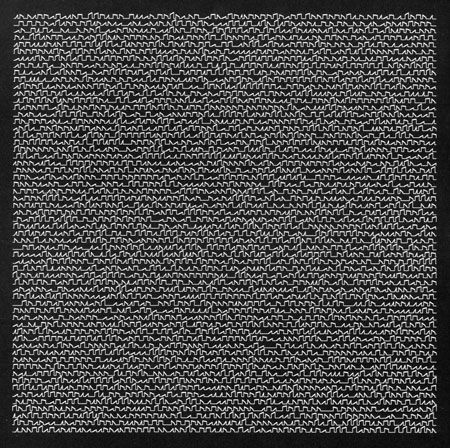
manfred mohr: P-122

During the vibrant period of 1969–73 Manfred Mohr, one of the precursors of digital art, created a series of algorithm-based works, in which a computer-driven calculation found its visual manifestation in print. Thereby he produced rules to code information.


This is an example of Mohr's work which he describes as follows:
Lines touching the horizontal base line are associated to the numbers 0-9. Lines which do not touch the horizontal base line and therefore are between 2 vertical lines are associated to the letters of the alphebet A-Z. In P122 letters and numbers are chosen randomly, thus creating a random text.

Mohr's thinking about a process of coding is very similar to mine. In my case though, content is equally important addressing questions of the nature of our language.

You can view more of Mohr's works here: http://www.emohr.com/ww4_out.html

2010-03-09

noisecode: IT+EN and PL+IT dna

Having transcribed a third language, I can now look for new noisecode DNA patterns inside these languages. Here is the Italian—English chromosome set and Polish—Italian for comparison.

noisecode: IT

After considerably long time (and with help of Davide Iemmola, my friend from CSM–MACD) I managed to code Italian alphabet. This posed rather different difficulties than in case of Polish alphabet, as instead of compressing the alphabet to fit my set of 28 variables (suited perfectly for English!) I had to extend the content. I managed to do this in a truly surgical fashion by throwing 5 noises away. My decision was to cut on the double-noise pairs, so the only doubles to remain would be 'space' and 'start' which remain constant in each language coding.


As said before, Italian alphabet consists of 21 letters (ABCDEFGHILMNOPQRSTUVZ), 10 digraphs (ch, ci, gh, gi, gl, gn, ha, qu, sc, zz) and 3 trigraphs (gli, sch, sci). These rules helped with assigning right letters to right noises.

2010-02-28

noisecode: interlingual chromosomes

There is an analogy between alphabets and DNA code in terms of how information is encoded with a closed set of certain variables. This can be observed in noisecode.

After filtering text through noisecode.en and noisecode.pl I found out that some patterns can be distinguished in which noises indicate various letters according to language code. After investigating the particular case of English-Polish noisecode relationship I produced what can be seen as 'noisecode interlingual chromosomes'.


There is 14 noisecode.en-pl chromosomes of varied length. Two types of noisecode chromosomes can be distinguished:
• loop chromosome—in which characters occurring in both languages form a closed interchanging path;
• open chromosome—in which opening and closing characters are specific to one of the alphabets only.

The general rule here is: the more chromosomes there is and the shorter they are—the better the transcription from one language via noisecode to the other. The most straightforward transcription depending on many short chromosomes can be produced by languages that have the least specific characters possible and the smallest number of digraph/trighraph/etc. rules.

noisecode: interlingual faultiness

Having a fixed set of variables (nucleobases in nucleic acids of DNA / zeroes and ones in informatics / letters in alphabet / noises in noisecode) we can encode with its use any piece of information we want. Information can be also transcribed from one code to another, providing the codes conform with one aother.
Since transcribing Polish into noisecode I have been able to experiment with two languages. Interestingly enough, what proved to be most fascinating now is the faultiness of transcribing from English into Polish and the other way round via noisecode. These are three examples of what happens:

• >HELLO_WORLD> is transcribed into a set of noises according to noisecode.en;
• transcribing this set noises back into letters but using noisecode.pl rules gives an output of: >ZUFFA_OASF[łż]>;
• transcribing >HELLO_WORLD> into a set of noises according to noisecode.pl ans then filtering it back through noisecode.en produces: >CUGGW_QWZGS>.

• >NOISECODE> processed through noisecode.en;
• noisecode.en set put through noisecode.pl: >JAILUHA[łż]U>.
• >NOISECODE> processed through noisecode.pl;
• noisecode.pl set put through noisecode.en: >PWIRUVWSU>.

• >PAŹDZIERNIK> (October in Polish) processed through noisecode.pl;
• noisecode.pl set put through noisecode.en: >NOHFSHIUZPIK>.
Note: there is an extra letter in the noisecode.pl-en output. This is due to double-coding of Polish special characters which are indicated by a set of two pairs of noises. In this particular case it is: Ź = [Z]+[ćńóśź].
• >PAŹDZIERNIK> processed through noisecode.en;
• noisecode.en set put through noisecode.pl: >N[ąę]R[łż]RIUSPIK>.
Note: the reverse situation occurs in this case. In order to transcribe letter Ź into noisecode.en it has to be simplified—therefore, Ź becomes Z in the noisecode.en output.

2010-02-25

noisecode: PL

Noisecode covers now a second language—Polish.
Polish contemporary alphabet contains 32 letters. There are 9 unique characters with diacritic symbols (Ą, Ć, Ę, Ł, Ń, Ó, Ś, Ź, Ż), and there is no Q, V and X—this makes a total surplus of 6 characters in comparison to English alphabet. Due to this number noisecode had to be either extended by a new noise, or special characters had to be combine-coded by a sequence of a base letter and a diacritic symbol. I chose the latter option, mainly because having kept a constant set of noises enables me to contrast and compare noisecode.pl with noisecode.en. Therefore, 9 characters in noisecode.pl are expressed with a set of two pairs of noises instead of a single pair as in case of standard letters.


Yellow lines indicate combine-coded special characters:
base letter linked with a diacritic symbol.
Grey lines indicate dighraph rules.
Dotted lines indicate a trigraph rule.

Apart from the set of noises used to code letters in noisecode.pl, there are some other important similarities shared with noisecode.en:
• all vowels are composed with the 'mains hum 60Hz' noise (with the 'Hum+Hum' pair coding the diacritic symbol used for A and E only and transforming them into nasal vowels);
• coding of start/stop and space stays the same;
• the digraph and a trigraph rule is used to code letter clusters.

Note two significant differences between noisecode.PL and niosecode.en which may have great impact on the final audio form of each language:
• Polish alphabet contains more characters and, therefore—according to the alphabet principle—...
• ...there is much less digraph/trighraph rules in Polish alphabet (PL=8/1 while EN=35/5).
2010-02-24

noisecode: towards human

My system is working. You can play with it on your own computer
(see the post from 15th Feb about a keyboard).
Now the only problem with this is... that the whole thing is stuck to a computer!
I wish to push my work out of this incomprehensible machine and let it exist in some more familiar, more trivial and—above all—in more human devices.

Provided that noisecode is the soul, then I consider these things as a possible body:
• keyboard,
• megaphone (bull horn),
• telephone,
• typeface,
• speakers in the underground's carriage.

Apart from that I recognise a need to assign noisecode to another language. In such case it will be Polish, not only because this is my mother tongue which I know well enough to understand rules of orthography, pronunciation and accentuation, but also due to how it is different from English in terms of the alphabetic principle, variety of dialects, vowel length.

2010-02-16

noisecode: brief recap

Noise used to be a distortion / pollution.
Can it be used to communicate?
Noise can be defined by a graphic shape—spectrum.

∇ ∇ ∇

Visual manifestation of language (written form)
becomes translated into an audio abstract form.
— — —
Abstract language becomes abstract noise...
NOISECODE
Abstract noise becomes abstract communication.
— — —
Everyday language is translated into new abstract
instantiation, which serves discovering language
properties that usually stay unknowing.

∆ ∆ ∆

Language has various manifestations.
A visual representation of language is the alphabet
consisting of graphemes which are abstract symbols.

2010-02-15

noisecode: why not phonetics?

One of the most challenging questions I've been usually asked regarding the noisecode project is: why not use the phonetic alphabet (IPA) instead of the letter (grapheme) alphabet—it would relate to noisecode better, as both would be of aural quality. My answer to such questions is simple: the main idea of noisecode project is to give an audio instantiation to the visual manifestation of a natural language—hence the 26-letter English alphabet.


Apart from that there are several minor reasons:
— phonetic transcription varies according to dialectic details of language (e.g. RP–General American—Cockney. This makes the phonetic alphabet imprecise and not universal;
—English letter alphabet has 26 variables, while English RP phonetic alphabet consists of 24 consonants and 23 vowels (plus 6 additional sounds used in foreign words). I picked the smaller alphabet, as the higher the numer of variables in the code, the more noises needs to be used / overlapped, which leads to decreasing respectively the distinctiveness / clarity of produced sounds.
—letter alphabet is commonly known unlike the phonetic IPA alphabet which is rather a specialist knowledge.

noisecode: keyboard

The first applet simulating noisecode keyboard can be viewed here:

http://www.marekkultys.com/applet/01/applet/index.html

Up to now noisecode has been available in 'read-only' version.
Now it has became interactive, enabling the viewer to translate any text.